
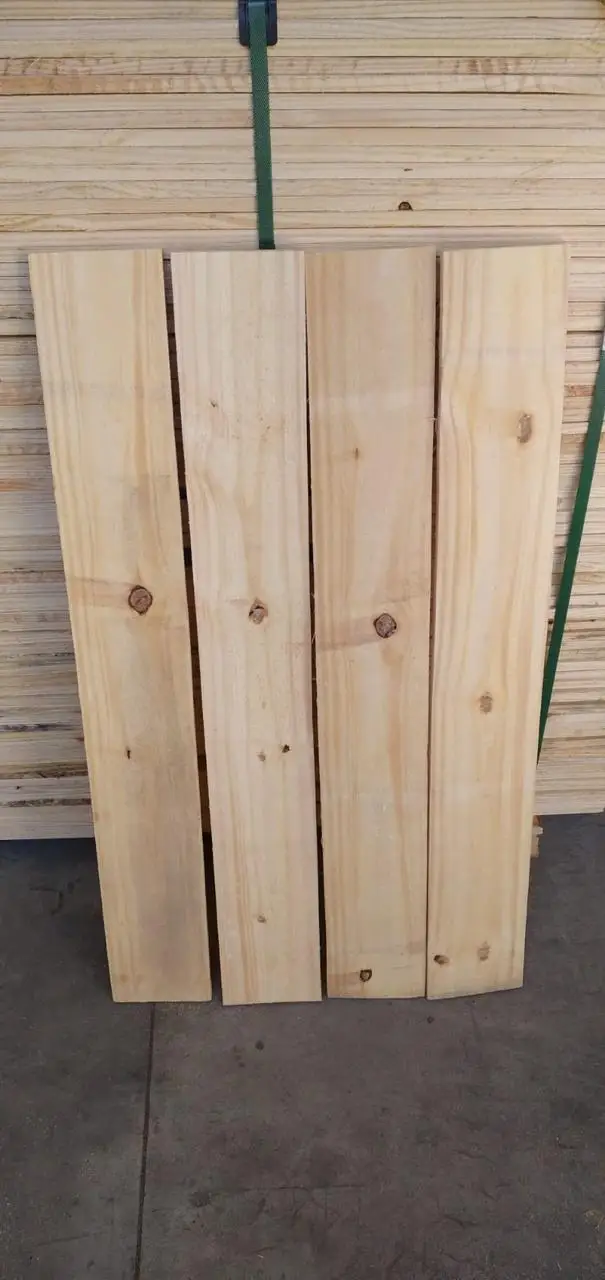
Lumber grades, also called wood grades, set how much of each visible defect a piece may have: knots, blue stain, wane, bark, cracks, insect holes and warp. In Europe the reference is EN 1611-1, with grades G4-0 to G4-4. Nordic trade still uses the older A, B and C scale, and the United States uses the NELMA and SPIB rules. In Brazilian pine exports, buyers mostly take grades A and B.
What lumber grading looks at
Each face and edge of the piece is assessed. The features that matter most:
- Knots. Sound, tight knots (grown into the surrounding wood) are allowed in more grades than dead or loose knots, which can fall out.
- Blue stain. Caused by fungi. Surface stain, under 2 mm deep, planes off; deep stain does not.
- Wane. The rounded log surface left on an edge, measured in width and as a percentage of length.
- Bark, checks and splits. A split that runs from one side to the other is the most restricted.
- Insect holes. Small pinholes left by larvae; active insect attack is never accepted.
- Pith. The soft, dark core at the centre of the log.
- Warp. Bow, spring, twist and cup, measured in millimetres over 2 metres.
- Moisture and size. Thickness, width and length tolerances are agreed at a reference moisture content.
The European standard: EN 1611-1
EN 1611-1 is the appearance grading standard for softwoods (pine, spruce and others) used in European trade. When all four sides are assessed, the grades are G4-0, G4-1, G4-2, G4-3 and G4-4, with 0 the best. G4-2 corresponds to typical building timber.
On size, the European standard EN 1313-1 allows pieces up to 100 mm to be up to 3 mm over and 1 mm under target, measured at 20% moisture content.
The Nordic scale: A, B and C
Before EN 1611-1, Nordic countries used the “Blue book” rules, which still appear in many contracts:
- A (split into A1 to A4): high-class joinery and visible finishes;
- B: the most common grade in construction;
- C: used, for example, in packaging.
There is no exact official conversion between this scale, EN 1611-1 and the US rules. That is why the grade has to be written into the order with the limit for each defect, not only the letter.
A and B grades in Brazilian pine exports
Brazilian sawn pine (Pinus taeda and Pinus elliottii) is exported mainly in two appearance grades:
- Grade A: for remanufacturing, industrial components, higher-value packaging and light structural use. Few visible defects and well-squared pieces.
- Grade B: allows blue stain, wane and larger knots. Suits packaging and uses where appearance matters less, at a lower price.
What LG Madeiras’ grade A allows
LG’s grade A sawn pine is kiln dried (KD), heat treated (HT) and, when the order requires it, FSC® 100% certified with EUDR documentation. The specification:
| Feature | LG grade A |
|---|---|
| Moisture content | 5% to 12% (12% max.) |
| Thickness tolerance | −1 mm / +2 mm |
| Width tolerance | −1 mm / +3 mm |
| Length tolerance | −1 mm / +3 mm |
| Blue stain | no |
| Mould | no |
| Wane | limited to 10% of the length |
| Bark | no |
| Checks and cracks | no |
| Pinholes | no |
| Pith | allowed |
| Tight knots | allowed |
| Dead knots | occasional, 1 to 3 mm |
For grade B, the limits for blue stain, wane and knot size are agreed in the order.
How to specify the grade in an order
- Write the grade and the limit for each defect; the letter alone means different things to different buyers.
- State the maximum moisture content and how it will be measured.
- Set the size tolerances.
- Give the end use (packaging, remanufacturing, construction); it decides which defects matter.
- Ask for photos of the bundles at loading.
For drying and treatment, see kiln dried and heat treated lumber (KD-HT) for pallets. To request a quote, see LG’s sawn pine lumber.
Sources: EN 1611-1 and EN 1313-1, as presented in “Grading of sawn timber in Europe according to EN 1611-1” (Swedish Wood, 2016); LG Madeiras 2026 export specification.