
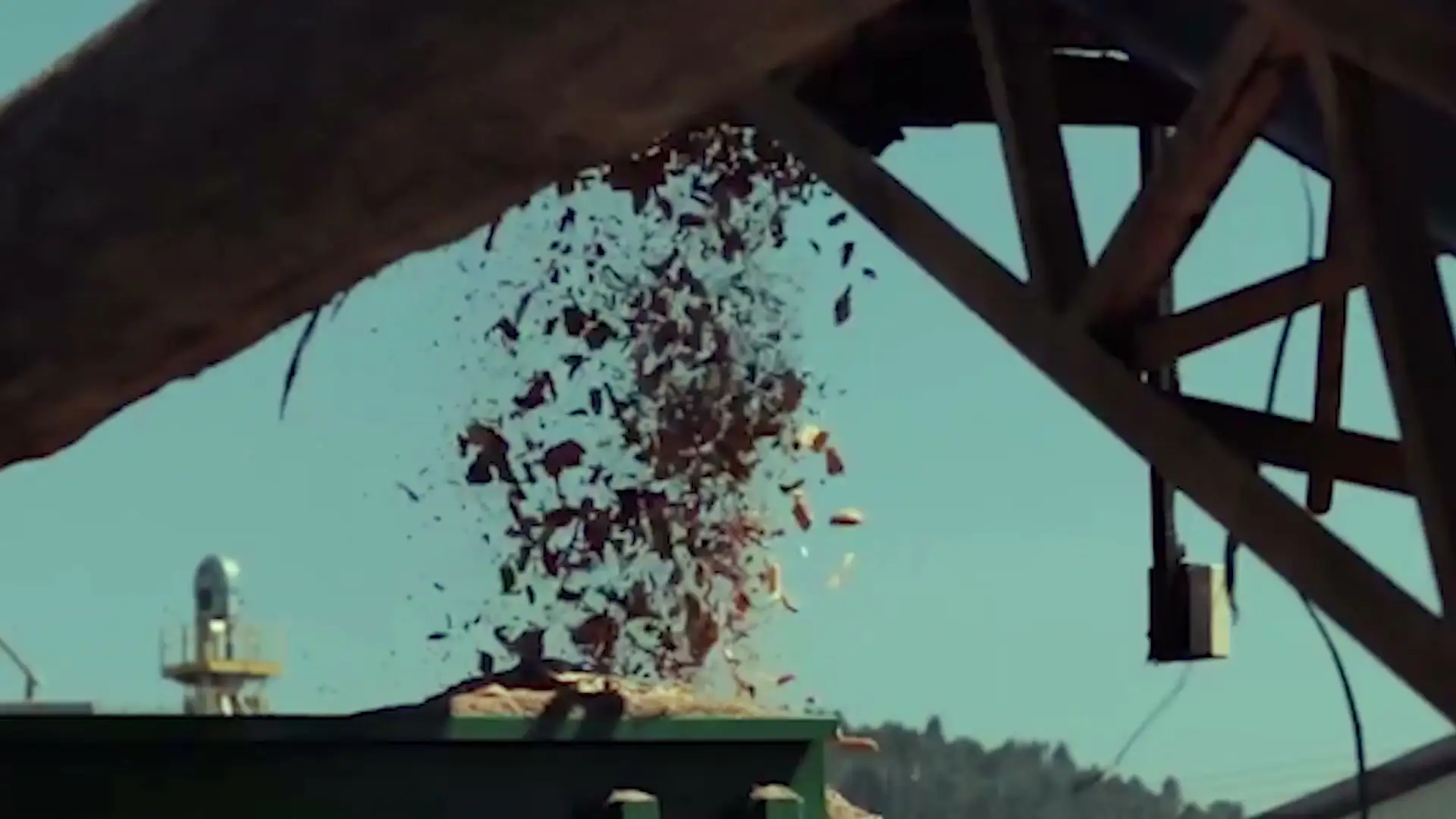
Wood chips are wood cut into pieces a few centimetres long, made from branches, slabs, edgings and sawmill offcuts. They are one of the most common biomass fuels for industrial boilers. What decides their value is moisture content: water does not burn, and part of the boiler’s heat goes into evaporating it. Sawdust is the fine dust a saw leaves behind, and wood pellets are dried, pressed sawdust, denser and with low, steady moisture.
Where wood chips come from
- From the forest: branches, treetops and thin trees chipped in the field. More bark and soil, so more ash when burned.
- From sawmills and peeling lines: slabs (the rounded outside of the log), edgings and clean offcuts. The most uniform chips, with little bark.
- From waste wood: old pallets and packaging. Watch for nails, paint and treated wood.
Wood chips for biomass boilers: moisture decides
What a boiler buys is energy. Freshly chipped wood can be half water by weight, and the boiler spends heat driving that water off before it can use the rest. The wetter the chips, the more tonnes the boiler burns for the same steam.
When buying wood chip fuel:
- compare price and moisture content together: a cheap, wet tonne can cost more per unit of energy;
- know whether the price is per tonne or per cubic metre: volume includes the air between pieces, weight includes the water;
- ask for the moisture content of every load in writing.
Sawdust
Sawdust is the dust and fine particles a saw leaves behind. It burns fast and is used in boilers built for it, in tobacco drying and, above all, as the best raw material for pellets: it is already fine and clean, with no need to chip it again.
Wood pellets
Wood pellets are dried sawdust pressed into small cylinders, 6 or 8 mm in diameter. The wood’s own lignin binds them in the press; good pellets contain no additives. Under the European ENplus standard, class A1:
- bulk density of at least 600 kg per cubic metre, several times that of chips;
- moisture of 10% at most;
- ash of 0.7% at most.
That is why biomass wood pellets are shipped across oceans and wood chips are not. Europe, and Italy in particular, is among the world’s largest consumers of wood pellets for home heating.
What to check when buying wood chips or sawdust
- Moisture content, measured and reported for every load.
- Origin: planted forest or clean industrial residue, with no treated or painted wood.
- Chip size that suits the boiler’s feed system.
- Bark and soil, which turn into ash and maintenance.
- Contamination from nails, stones or plastic.
- Steady supply, especially in winter, when everyone wants biomass at once.
Wood chips at LG Madeiras
At LG, whatever does not become sawn lumber or veneer becomes biomass. Chips from the peeling line fuel our own boiler, whose steam dries lumber in the kilns and conditions the logs before peeling. Pine and eucalyptus chips and sawmill sawdust are sold to other industries’ boilers and to pellet plants, and sawdust also goes to local farmers for tobacco drying.
Our wood chips and sawdust are supplied regionally in Santa Catarina, Brazil, by our own fleet or collected at the mill in Ituporanga; they are not exported. See logs, biomass and firewood, or, for export products, our sawn pine lumber and eucalyptus and pine veneer.
Source: ENplus standard (class A1), based on ISO 17225-2.