
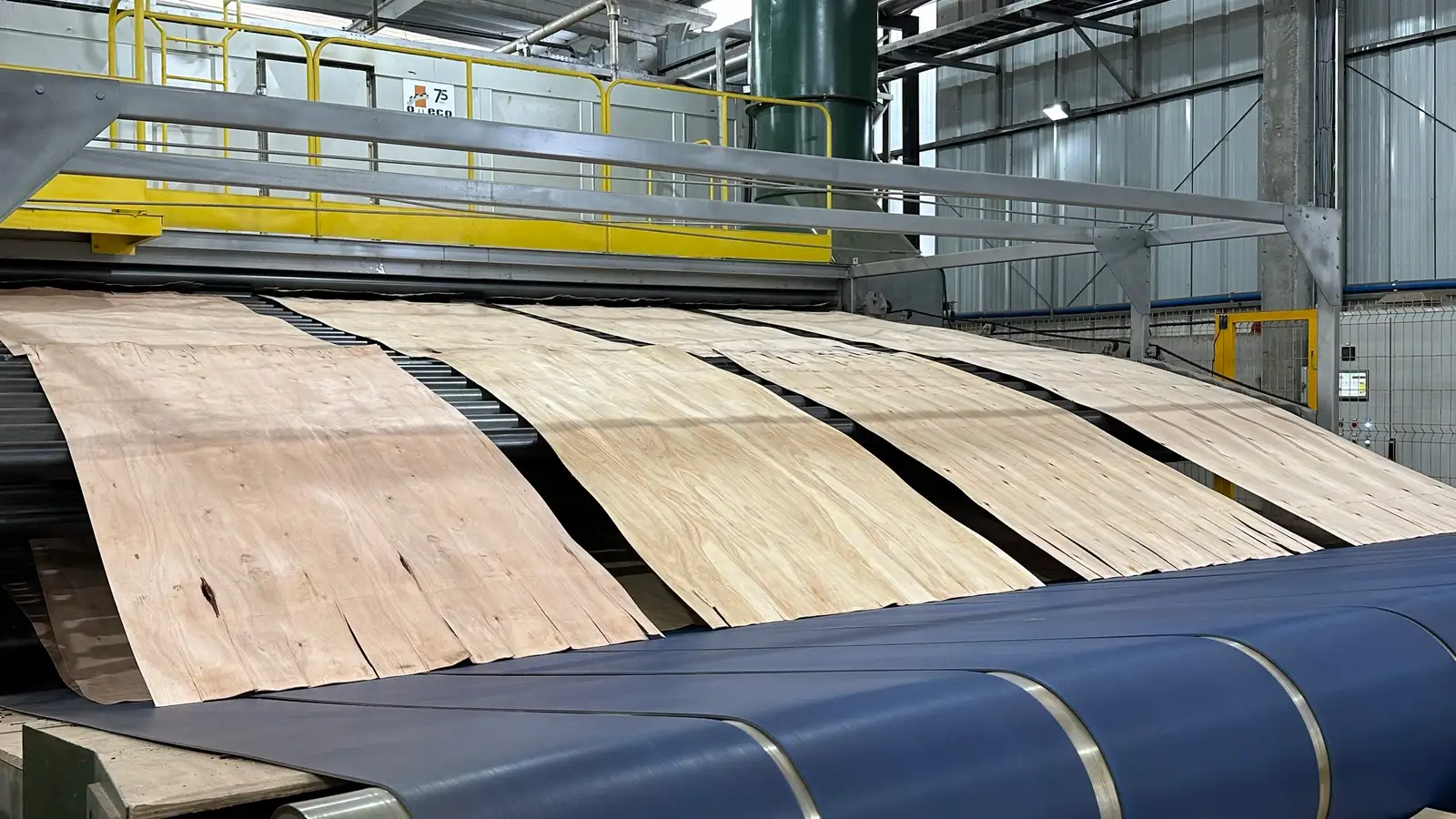
Eucalyptus core veneer for LVL and plywood has to match from one lot to the next: same species, same moisture content, same thickness. In laminated veneer lumber (LVL) a beam is dozens of plies glued in the same direction, and each ply carries its strengths and flaws into the finished piece. That is why manufacturers judge a veneer supplier on eight points, from species control to EUDR paperwork.
1. Species, and whether the lot stays the same
The eucalyptus used for LVL and structural plywood in Brazil is mainly Eucalyptus grandis and Eucalyptus dunnii, from plantations. Both have good density and mechanical strength for structural use, but they are not identical. If your press and glue recipe are tuned to one, mixing them without knowing changes the result.
Ask whether the supplier can ship lots of grandis only, dunnii only or mixed, and whether that is written into the order. A lot sold simply as “eucalyptus” can change from one container to the next.
2. Moisture after the dryer
The moisture the veneer arrives with sets up your bonding. Veneer that is too wet blisters in the press; uneven moisture within one bundle bonds unevenly. Ask what moisture range is agreed, how it is measured and whether the reading is recorded per lot.
3. Thickness and tolerance
In LVL, a tenth of a millimetre per ply becomes millimetres across the beam. Ask for the nominal thickness and the tolerance, in writing, and check it on arrival. A supplier who quotes thickness without a tolerance is not controlling it. Thickness ranges, sheet sizes and the ply arithmetic are in plywood core veneer thickness and sizes.
4. Lathe checks
As the log turns against the knife, the lathe opens small cracks on the loose side of the veneer: lathe checks. The deeper they are, the more glue the veneer absorbs and the weaker the bond. What reduces them is steam-conditioning the logs before peeling. The difference shows up in your glue consumption.
5. Grading and inspection
Knots, end splits, stains and holes have different limits for core and face veneer. Agree on the grading in writing and ask where the veneer is inspected: during production, at the dryer outlet or only at packing. Inspections recorded per lot let you trace a problem back to the day the veneer was made.
6. Packing and loading
Poorly packed veneer arrives crushed, with broken ends or wet from container condensation. Ask for loading photos: the door, the interior and every layer of bundles.
7. Paperwork: FSC® and EUDR
Much of the LVL and plywood made in Asia is sold in Europe and the United States. With the EUDR applying in the European Union from 30 December 2026 for large and medium companies, your European customer will ask for the origin of the wood back to the forest, and you will need to pass on what you received from your veneer supplier. Ask for FSC® certification and an origin dossier with forest geolocation with every shipment. We cover this in EUDR for timber.
8. Steady supply
An LVL, plywood or engineered flooring mill needs veneer every week. A supplier that buys logs on the open market for each order is exposed to swings in supply, diameter and species. Ask where the logs come from.
How LG Madeiras does it
LG’s peeling line started in 2023 in Ituporanga, Santa Catarina, Brazil. We peel Eucalyptus grandis, Eucalyptus dunnii and pine from our own planted forests and partner forests, harvested by our own crews. Lots ship as grandis only, dunnii only or mixed, as ordered.
Logs are steam-conditioned before the lathe. Veneer is inspected during production and at the dryer outlet under a standard procedure, and every inspection is recorded against the lot. Thickness, sheet size, moisture and grading are agreed in writing in the proposal. Each shipment carries the EUDR origin dossier, the FSC® claim when the order is certified and the container dispatch report with photos of every layer.
See LG’s eucalyptus and pine veneer or send us your specification through the form.