
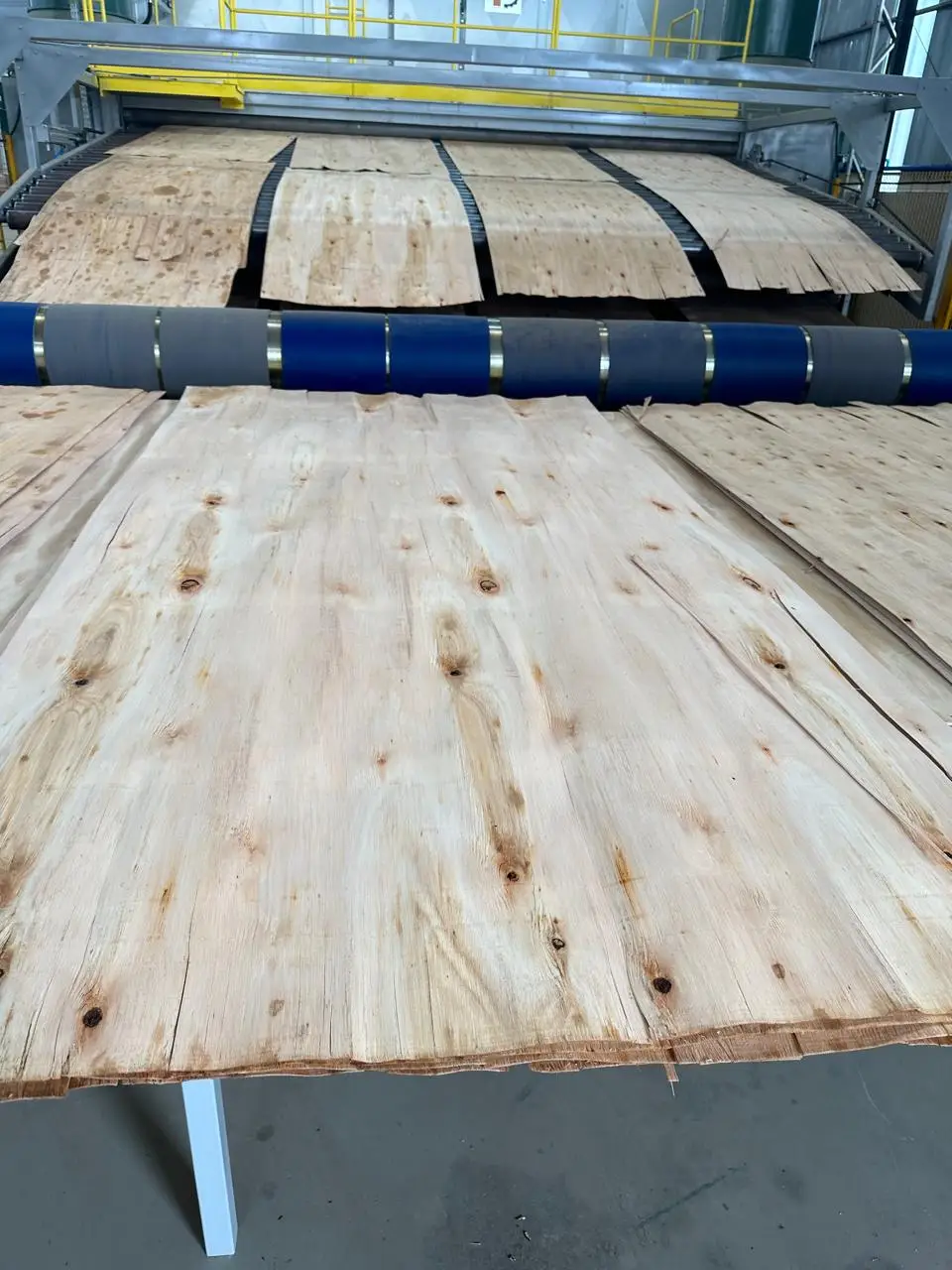
Plywood core veneer thickness comes from the finished panel and the number of plies; at LG Madeiras veneer runs from 1.8 to 4.0 mm, in 4×8 ft (1220 × 2440 mm), 4×4 ft or European sheet sizes. The arithmetic starts with the faces, which are thinner: in an 18 mm panel with 1.0 mm faces, seven 2.3 mm core veneers complete the panel. Nominal thickness alone is not a spec, though. Without tolerance, moisture and grade in writing, two containers of the “same” veneer will press into different panels.
This article covers the specification. What to check in the supplier itself (species, lathe checks, paperwork) is in eucalyptus core veneer for LVL and plywood.
What core veneer thickness should you use?
Start from the panel you sell and work backwards. Core veneer thickness comes from four numbers: finished panel thickness, face veneer thickness, number of plies, and how much your line loses in the press and the sander.
Two references narrow the range:
- LG range: 1.8 to 4.0 mm. Thicker veneer means fewer glue lines; thinner veneer means more plies and a better balanced panel.
- US standard PS 1 (structural plywood): in panels of 3/8 in (about 9.5 mm) or thicker, veneer must be at least 2.5 mm (1/10 in), and no inner-layer veneer may exceed 7.9 mm (5/16 in) (PS 1-19, section 5.5.1).
The detail that catches exporters to the United States: veneer under 2.5 mm works for a lot of plywood, but it is below the PS 1 minimum for structural panels. If the panel will carry a PS 1 stamp, order 2.5 mm or more.
How many plies are in 18 mm plywood?
Start with the faces. In higher-quality plywood, the two outer faces use higher-grade veneer (A, B or C+) so the panel looks good. Because that veneer costs more and is sold by the cubic metre, faces are usually thinner, 1.0 to 1.5 mm: the thinner the sheet, the less each one costs. Take the two faces off the panel thickness first, and only then count the core plies.
Then add up the dry thickness of every veneer and compare it with the finished panel. The difference is what the press compresses and the sander removes, and that number belongs to your mill: measure it on your line before you place the order.
| Faces (each) | Core | Core veneers | Total plies | Total before pressing |
|---|---|---|---|---|
| 1.0 mm | 1.8 mm | 9 | 11 | 18.2 mm |
| 1.0 mm | 2.3 mm | 7 | 9 | 18.1 mm |
| 1.0 mm | 2.6 mm | 7 | 9 | 20.2 mm |
| 1.5 mm | 3.0 mm | 5 | 7 | 18.0 mm |
| 1.5 mm | 3.3 mm | 5 | 7 | 19.5 mm |
The table shows the real trade-off. With 1.5 mm faces and five 3.0 mm cores, the total sits at 18.0 mm and any loss leaves the panel under nominal. With 3.3 mm cores, or with 1.0 mm faces and 2.6 mm cores, there is room. More thin plies give a better balanced panel, with more glue lines. Veneer manufacturing tolerance (see below) also goes into this sum.
Standards also limit the layup:
- PS 1, Table 4: panels over 3/8 in through 3/4 in (18 mm falls here) need at least 5 plies.
- PS 1, section 5.8: cross-grain wood must make up 33% to 70% of panel thickness, and inner layers at least 45% in panels of 4 plies or more. Run this check with the real face and core thicknesses, because thinner faces change the proportion.
- IS 303 (India, general-purpose plywood): classifies panels by number of plies — 3, 5, 7, 9, 11 and above — according to the BIS certification manual (Dec 2018).
An odd number of plies, with the same thickness on both sides of the centre, is what keeps the panel flat. That is why core veneer in one lot has to arrive at one thickness: a thicker sheet on one side throws the panel out of balance.
What veneer thickness tolerance should you ask for?
Ask for nominal thickness and tolerance together, and say how it will be measured. In veneer manufacturing, tolerance typically runs from 0.20 mm under to 0.20 mm over nominal. LG normally works to 0.10 mm under and 0.20 mm over: for a 2.6 mm veneer, 2.5 to 2.8 mm. Because the variation repeats in every ply, it goes into the panel arithmetic. PS 1 allows up to 5% variation in average thickness, measured dry before layup (section 5.5.1).
Three things to put in the order:
- Nominal and tolerance in millimetres, not only as a percentage: “2.6 mm, −0.10 / +0.20 mm” leaves no room for a different reading.
- When to measure: dry, after the dryer. Green veneer will still shrink.
- Average or point by point: PS 1 talks about the average. If your press or sander needs a per-point limit, write it down.
Tolerance matters more in laminated veneer lumber (LVL). Every ply runs in the same direction, and a small error in each veneer adds up across the thickness of the beam.
Which core veneer sizes are available: 4×8, 4×4 and European?
The sheet size follows the panel you press. LG Madeiras supplies veneer in these sizes:
| Size | Nominal | Oversize for trimming |
|---|---|---|
| 4×8 ft | 1220 × 2440 mm | 1270 × 2540 mm |
| 4×4 ft | 1220 × 1220 mm | 1270 × 1270 mm |
| European | 1250 × 2500 mm | 1300 × 2600 mm |
Oversize leaves 25 mm on each side (on the European size, 25 mm each side across the width and 50 mm each side along the length) for trimming the panel after pressing. It pays when layup drifts a little or when edges arrive with broken corners: the trim takes the defect away.
The 4×4 sheet is useful for cross plies, where the grain runs across the panel width. Two 4×4 sheets side by side cover a 4×8 panel. LG does not produce 4×2; for that layup, order 4×4 or 4×8 and cut it at your mill.
State in the order which way the grain runs relative to the long dimension. On a square sheet it makes no difference; on 4×8 it separates long-grain veneer from cross-grain veneer.
What moisture content should core veneer have?
The right moisture is the one your glue and press call for (at LG, veneer ships at 0% to 15% depending on the order, most often 8% to 10%), written into the order together with the measuring method. Urea, phenolic and melamine resins work in different ranges; the panel maker sets the range from the resin data sheet.
Do not confuse it with the figure in panel standards. PS 1 limits the moisture of finished plywood to 18% at the time of shipment (section 5.11). That limit is about the panel, not about the veneer going into the press.
What to write:
- A moisture range (minimum and maximum) instead of a single figure.
- Where and how it is measured: at the dryer outlet, with a calibrated meter or by oven-drying a sample.
- What happens to veneer outside the range: sorted out, redried or rejected.
How does core veneer grade differ from face veneer grade?
The face is the visible surface and carries the panel’s appearance; the core sits inside and carries its strength. So defect limits are different. For faces, mills sort out the higher-grade veneer (A, B or C+). For the core, the standard is C/D-grade veneer unless the order is special. Under PS 1, an A-A panel (A face on both sides) can have D-grade inner plies in Exposure 1 grades; in Exterior grades the minimum for inner plies is C (Tables 2 and 3).
Sound knots and stains are usually accepted in core veneer. What causes trouble is anything that opens a void inside the panel:
- Splits and broken edges: they become gaps between veneers. PS 1 limits crossband and centre gaps to 25.4 mm (1 in) near the panel edge and 12.7 mm (1/2 in) on average across the panel (section 5.8.1).
- Uneven thickness within one sheet: it leaves spots without press pressure, where the glue does not bond.
- Waviness: it slows layup and increases overlaps.
Write the core grade with a limit for each defect. A letter alone (“C/D core”) means different things to different buyers.
How to write a core veneer specification in an order
A complete spec fits in eight lines. This is the template we recommend sending with a request for quotation:
| Item | Example |
|---|---|
| Species | Eucalyptus grandis (or dunnii only, or mixed) |
| Use | core of 18 mm plywood, 1.0 mm faces, 9 plies |
| Nominal thickness | 2.3 mm |
| Tolerance | −0.10 / +0.20 mm, measured dry after the dryer |
| Size | 1270 × 2540 mm, grain along the length |
| Moisture | range set by your resin, with measuring method |
| Grade | C/D core, with limits for knots, splits and broken edges |
| Packing | strapped bundles, photos of every layer in the container |
Before you send it, check:
- Faces plus core, with tolerance and minus your line’s loss, give the nominal panel.
- Thickness meets the panel standard (PS 1, IS 303 or the one in your market).
- The sheet size has the oversize your trimming needs.
- Moisture and tolerance each have a written measuring method.
How LG Madeiras does it
LG peels Eucalyptus grandis, Eucalyptus dunnii and pine in Ituporanga, Santa Catarina, Brazil, from logs grown in its own and partner plantations. Lots ship as grandis only, dunnii only or mixed, as the order specifies. Logs are steam-conditioned before the lathe.
Veneer runs from 1.8 to 4.0 mm, with a normal tolerance of 0.10 mm under and 0.20 mm over. Standard core grade is C/D; another grade on special order. Moisture ranges from 0% to 15% depending on the order; 8% to 10% is the most common. Sheet sizes are the ones in the table above, with or without oversize. Veneer is inspected during production and at the dryer outlet. Moisture, thickness, size and grade are agreed in writing for every order. Every shipment carries the timber origin dossier for the EUDR.
See LG eucalyptus and pine veneer and send your spec — thickness, size, moisture and grade — through the form to receive a proposal.
Sources
- U.S. Department of Commerce / NIST. Voluntary Product Standard PS 1-19, Structural Plywood — sections 5.5.1 (veneer thickness), 5.8 and Table 4 (construction), 5.8.1 (gaps), 5.11 (moisture), Tables 2 and 3 (grades). 2019 text published by NIST, consulted November 2026.
- Bureau of Indian Standards. Product Manual for Plywood for General Purposes according to IS 303:1989 (Dec 2018) — classification by number of plies.
- Sheet sizes, thicknesses and process: LG Madeiras veneer specification, 2026.