
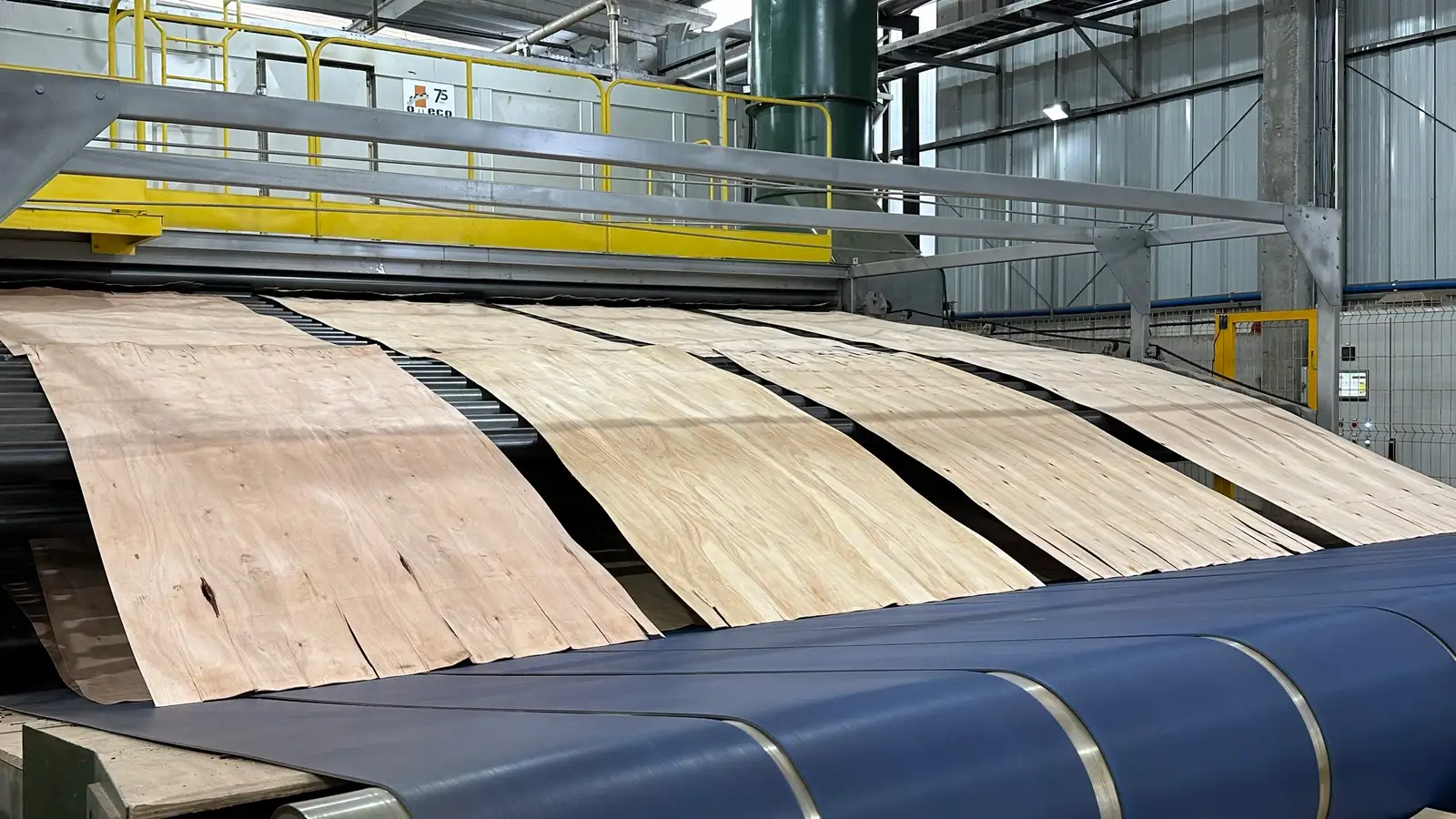
Plywood is made by peeling logs into thin veneer, drying it, gluing the sheets with the grain of each one running across the one below, and pressing the stack under heat into a flat panel. The US Environmental Protection Agency counts nine steps in a plywood mill, from log storage to sanding. The details that decide whether a panel comes out flat, well bonded and on thickness sit inside those four verbs, and that is where core veneer is won or lost.
This guide goes through the sequence in order. Where a step changes what a buyer should ask for in core veneer, it says so.
How plywood is made, step by step
| # | Step | What happens |
|---|---|---|
| 1 | Log storage | Logs wait in the yard until they are processed |
| 2 | Debarking and cutting to length | Bark comes off; logs become blocks the length of the lathe |
| 3 | Steam conditioning | Blocks are heated and soaked so they peel cleanly |
| 4 | Peeling | A lathe turns the block against a knife and cuts a continuous sheet |
| 5 | Clipping and sorting | Sheets are cut to size and sorted by grade |
| 6 | Drying | Veneer goes through a dryer to the moisture the glue calls for |
| 7 | Glue spreading and layup | Resin is spread and veneers are stacked cross-grain |
| 8 | Pressing | Heat and pressure cure the glue |
| 9 | Trimming, sanding and panel grading | The panel is squared, sanded and graded |
The nine-step list follows the US EPA’s description of softwood and hardwood plywood mills (AP-42, section 10.5, January 2002). Mills vary in the details, and some skip steps that others take.
What happens to the log before peeling: debarking and steam conditioning
The log is debarked first, without damaging the wood, and cut into blocks the length of the lathe. FAO gives a normal lathe length of 240 to 270 cm. The block is then heated: the US EPA describes heating to around 93 °C in hot water baths, steam, hot water sprays or a combination, so that the lathe cuts better and the veneer has a better surface (AP-42, 2002). FAO calls the step conditioning and describes it as exposing the blocks to both heat and moisture (FAO Forestry Paper 93, 1990).
Cold, hard wood tears under the knife. Heated wood is softer and peels with less resistance, and the veneer comes off with a smoother face and fewer cracks on the side that was against the knife. At LG Madeiras the logs are cooked with steam before the lathe.
For the buyer: this step is why two veneers of the same species and thickness can glue differently. Ask whether the supplier conditions logs before peeling. It is the main control over lathe checks (see the next section).
How is veneer peeled? Rotary lathe, knife and lathe checks
Veneer is peeled on a rotary lathe: the block turns around its axis while a knife cuts a continuous sheet, like unrolling paper from a roll. The US EPA notes that the wood is compressed by a nosebar, a bar that presses on the wood just ahead of the knife, while the knife cuts, and that typical veneer is around 3 mm thick. Decorative veneer is sliced much thinner (AP-42, 2002). In plywood for construction and for packaging, almost all veneer is rotary cut (FAO, 1990).
Two things happen on the knife side of the sheet. The knife opens fine cracks called lathe checks (also knife checks). The side with the cracks is the loose side, and the other is the tight side. The deeper the checks, the more glue the veneer soaks up and the weaker the bond across that ply. What sets their depth is the combination of wood temperature, knife and nosebar setting and veneer thickness. Machine settings and numbers vary from mill to mill, and this article does not quote any.
A spindleless lathe holds and turns the log by rollers on its outer surface instead of by spindles at both ends. Without spindles in the middle, the block can be peeled down to a smaller core. One manufacturer lists a minimum core diameter of 30 mm for its spindleless lathe (Raute, model R3 data sheet). The patent literature points out the trade-off: this type of lathe works best with logs that were rounded first. It suits plantation eucalyptus and pine, where logs are of modest diameter.
For the buyer: thickness and lathe checks are set here. Veneer that is not uniform in thickness cannot be fixed later. The thickness arithmetic, with tolerance, is in plywood core veneer thickness and sizes.
Clipping and sorting: how veneer is sized and graded
The continuous sheet is clipped into pieces. FAO describes green veneer clipped to size by hand or by high-speed knives, then graded, stored and cleared of defects. The US EPA gives a typical clipped width of 1.37 m (54 in), which leaves room for shrinkage and trim (AP-42, 2002). Sorting at this point separates veneer for the faces from veneer for the core.
For the buyer: this is where sheet size is decided. A veneer that will be trimmed after pressing is clipped oversize.
Why is veneer dried, and to what moisture?
Peeled veneer is wet, and glue does not bond to wet wood. The dryer brings it to the moisture the resin and the press need. The sources give different ranges: the US EPA reports veneer dried to between 1% and 15% moisture (dry basis), with a target that depends on the resin, at typical dryer temperatures of 150 to 200 °C (AP-42, 2002). FAO describes 2% to 10% and temperatures of 90 to 160 °C (1990). FAO adds that veneer drying accounts for some 70% of the thermal energy used in plywood production.
Veneer that leaves the dryer outside the target goes back through a redryer. At LG Madeiras, veneer is dried with steam from the company’s own biomass boiler and ships at 0% to 15% depending on the order, most often 8% to 10%.
For the buyer: write moisture as a range, with the place and method of measuring. The Wood Handbook (FPL-GTR-282, 2021, chapter 13) advises keeping veneer moisture as low as practical for cold-setting glues, because dry veneer is brittle and hard to handle, and puts the minimum practical level at about 4%. Which end of the range is right depends on your glue.
How is veneer graded: face and core?
After drying, veneer is sorted again by appearance. The panel standard (PS 1, the US structural plywood standard) names veneer grades N, A, B, C Plugged, C and D, from smooth and paintable to utility grade. The face is the visible surface and takes the higher grades; the core sits inside and accepts knots, small splits and stains that a face would not. At LG Madeiras the standard core grade is C/D, and another grade can be set on special order. Veneer is inspected during production and at the dryer outlet.
For the buyer: a letter alone (“C/D core”) means different things to different buyers. Agree on limits for knots, splits and broken edges. How to write that into an order is in plywood core veneer thickness and sizes.
How are glue and layup done: cross-grain and an odd number of plies
Resin is spread by roller spreaders, curtain coaters or spray. The US EPA names two main resins: phenol-formaldehyde for softwood plywood and exterior grades of hardwood plywood, and urea-formaldehyde for interior grades of hardwood plywood. Resin generally goes on both sides of one ply, which is then placed between two plies without resin (AP-42, 2002).
Each ply is laid with its grain at 90 degrees to the neighbour. The panel has to be symmetrical on both sides of a neutral centre, or it warps. That is why plywood has an odd number of plies: a five-ply panel has a back with the grain along the panel, a cross ply, a centre ply with the grain along the panel, another cross ply, and a face. The US EPA describes this exact sequence. Cross-graining is also what gives plywood strength in both directions and dimensional stability.
The standards add limits. For PS 1 structural plywood, panels over 3/8 in through 3/4 in need at least 5 plies, and cross-grain wood must make up 33% to 70% of the thickness (PS 1-19, Table 4 and section 5.8). India’s IS 303 for general-purpose plywood classifies panels by ply count (3, 5, 7, 9, 11 and above), according to the BIS product manual (December 2018).
For the buyer: the odd-ply rule is why core veneer has to arrive at the same thickness in every lot. A thicker sheet on one side of the centre throws the panel off balance.
How are plywood panels pressed: cold press and hot press
Pressing has two jobs: to squeeze the glue into a thin layer over each sheet and to activate the resin. The US EPA gives typical hot press temperatures of 132 to 165 °C for softwood plywood and 107 to 135 °C for hardwood plywood, for 2 to 7 minutes, depending on species, resin and press design (AP-42, 2002). FAO reports hot-press platen temperatures of 80 to 180 °C, in presses of 5 to 25 openings (called daylights). Some lines also use a cold press before the hot press, to flatten the stack and move the glue between plies, though FAO notes that newer lines no longer use it (1990).
For the buyer: the press compresses the panel, and the thickness lost is a number from your own line. Measure it before fixing the veneer thickness in the order.
Trimming, sanding and panel grading
After pressing, the edges are trimmed and the panel is sanded to its final thickness. FAO describes trimming saws followed by wide-belt or drum sanders, and gives 1220 × 2440 mm as a common panel size (1990). Panels are then graded by the veneer on the face and the back, which is why grades are written in pairs such as A-B or B-C (APA, The Engineered Wood Association, grade guidance for PS 1).
For the buyer: whatever the sander removes comes out of the veneer thickness you paid for. This is the reason face veneer is thin and core veneer carries most of the thickness.
How is LVL made, and how does it differ from plywood?
LVL (laminated veneer lumber) is made the same way up to the press, but the veneers are generally laid with the grain in the same direction, instead of crossing each ply. Natural Resources Canada describes the veneers as usually parallel to each other, which gives a beam or board that is strong along its length. Some European manufacturers produce LVL with a few cross-laid veneers for more dimensional stability.
Because every ply runs the same way, a small thickness error in each veneer adds up across the beam. That is why tolerance matters more in LVL than in plywood. What else to check in the supplier is in eucalyptus core veneer for LVL and plywood.
Where core veneer fits, and what a plywood maker should ask for
Core veneer is the inside plies of the panel, between the faces. It is the bulk of the panel by thickness, and it is the veneer that goes through steps 3 to 6 above most often. Five points carry over from the process to the purchase order:
- Thickness and tolerance in millimetres, measured dry after the dryer (peeling and drying).
- Moisture range and how it is measured (drying).
- Lathe checks: ask if logs are conditioned with steam before peeling (conditioning and peeling).
- Grade with limits for each defect (sorting and grading).
- Sheet size, with oversize if you trim after pressing (clipping).
How LG Madeiras fits in
LG Madeiras does not make plywood. It supplies the veneer that goes inside it. In Ituporanga, Santa Catarina, Brazil, LG peels Eucalyptus grandis, Eucalyptus dunnii and pine from its own and partner plantations, as grandis only, dunnii only or mixed, depending on the order. Logs are steam-conditioned and peeled on a spindleless lathe, and veneer is dried with steam from LG’s own biomass boiler. It is inspected during production and at the dryer outlet.
Veneer runs from 1.8 to 4.0 mm, with a normal tolerance of 0.10 mm under and 0.20 mm over. Moisture is agreed per order, from 0% to 15%, most often 8% to 10%. Standard core grade is C/D. Sheet sizes are 4×8 ft, 4×4 ft and European. When the order is certified, LG supplies FSC 100% veneer.
See LG eucalyptus and pine veneer and send your specification (thickness, size, moisture and grade) through the form to receive a proposal.
Sources
- U.S. Environmental Protection Agency. AP-42, Compilation of Air Emissions Factors, Chapter 10.5: Plywood Manufacturing, process description (10.5.2). January 2002. Consulted November 2026.
- FAO. Energy conservation in the mechanical forest industries, FAO Forestry Paper 93, section 1.3, plywood production. Rome, 1990.
- U.S. Department of Commerce / NIST. Voluntary Product Standard PS 1-19, Structural Plywood: grades of veneer, Table 4 and section 5.8. 2019.
- Bureau of Indian Standards. Product Manual for Plywood for General Purposes according to IS 303:1989. December 2018.
- Forest Products Laboratory. Wood handbook: wood as an engineering material, General Technical Report FPL-GTR-282, chapter 13 (drying and control of moisture content), glued wood products. Madison, WI, 2021.
- Natural Resources Canada. Laminated veneer lumber.
- Raute. Veneer lathe R3: minimum core diameter, spindleless lathe data sheet.
- LG Madeiras veneer process and specification, 2026.