
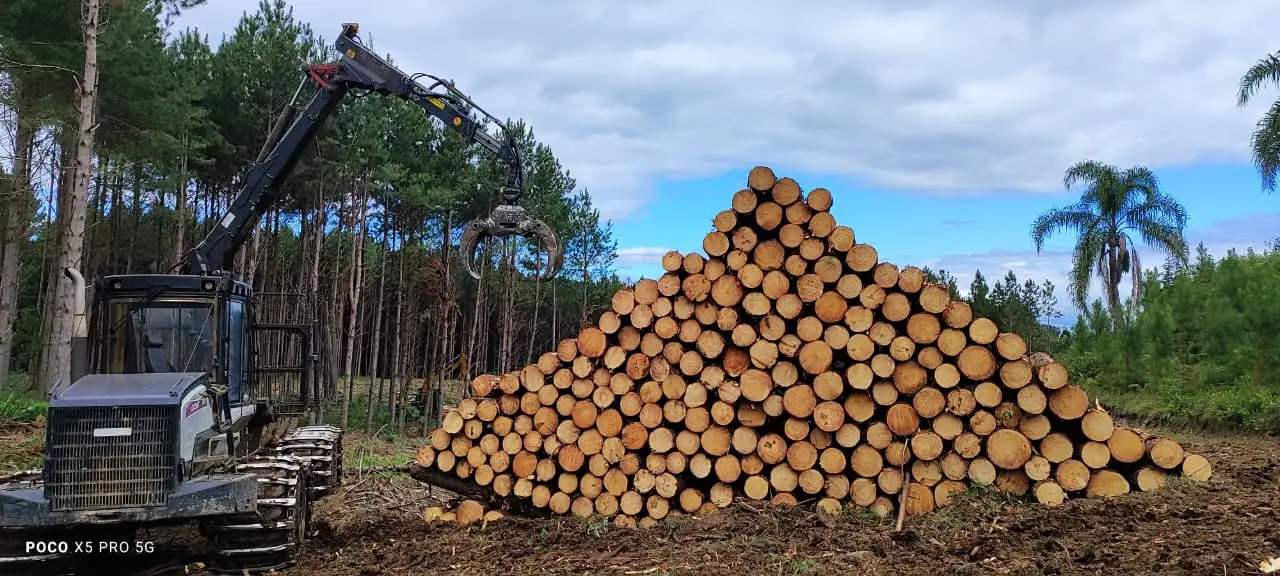
For pallet stock, packaging lumber and veneer, the difference between loblolly pine (Pinus taeda) and slash pine (Pinus elliottii) is small. In 13-year-old plantations in Paraná, Brazil, both species had the same density at 12% moisture (0.44 and 0.43 g/cm³) and the same bending strength (Delucis et al., 2013). They differ in where each grows best, in resin content and in the age at which the tree starts forming mature wood. That is why Brazilian export specs read “Pinus elliottii/taeda”. What really changes a shipment is something else.
Loblolly and slash pine: the same southern pines, planted in Brazil
Both species are native to the southeastern United States, where they belong to the southern pine group with longleaf and shortleaf pine. Brazil brought them in through the São Paulo State Forest Service in 1948, and large plantations started in the 1960s in the South and Southeast. According to Embrapa Florestas (Shimizu and Sebbenn, 2008), both tolerate frost well, but each has its region:
| Loblolly pine (P. taeda) | Slash pine (P. elliottii) | |
|---|---|---|
| Native range (US) | Maryland to Florida and east Texas | Florida, north to South Carolina and west to Louisiana |
| Where it grows best in Brazil | southern highlands up to northern Paraná | the whole South and part of the Southeast |
| Climate | colder sites; for severe frost (Rio Grande do Sul and Santa Catarina highlands), cold-winter seed sources | tolerates frost and moderate drought; accepts wet soils |
| Volume growth | higher on the cold highlands | lower than loblolly on cold sites, higher in northern Paraná, São Paulo and the southern coast |
Plantation pine in Brazil is concentrated in the South. In the 2017 report of the Brazilian Tree Industry association (IBÁ, 2016 data), Paraná held 42% of the country’s pine area and Santa Catarina 34%.
Density and strength of loblolly vs slash pine
In US-grown trees, slash pine is denser and stronger. In young Brazilian plantations the gap disappears. The two data sets do not measure the same thing:
| Property | Loblolly (P. taeda) | Slash (P. elliottii) | Source |
|---|---|---|---|
| Specific gravity, wood at 12% (US) | 0.51 | 0.59 | Wood Handbook, USDA FPL, 2021 |
| Modulus of rupture, 12% (US) | 88 MPa | 112 MPa | Wood Handbook, 2021 |
| Modulus of elasticity, 12% (US) | 12.3 GPa | 13.7 GPa | Wood Handbook, 2021 |
| Density at 12%, 13-year plantation (Brazil) | 0.44 g/cm³ | 0.43 g/cm³ | Delucis et al., 2013 |
| Modulus of rupture, 13-year plantation (Brazil) | 54.5 MPa | 54.4 MPa | Delucis et al., 2013 |
| Modulus of elasticity, 13-year plantation (Brazil) | 7,185 MPa | 5,841 MPa | Delucis et al., 2013 |
The Wood Handbook values come from small clear specimens of US-grown trees, and its specific gravity uses ovendry weight over volume at 12%. The Brazilian study used weight and volume at 12%. In the Brazilian samples (Araupel, Quedas do Iguaçu, Paraná), the differences between the two species in density, bending strength and stiffness were not statistically significant.
Juvenile wood: why log age matters more than species
Juvenile wood is the wood a pine forms in its first growth rings, around the pith. It has low density, short tracheids (the fibres of softwoods), thin cell walls, lower strength and a higher tendency to collapse in drying (Embrapa Florestas, 2008). Every pine log has a juvenile core. Its size is what varies.
This is where the species do differ. Slash pine starts forming mature wood at around 7 to 8 years. Loblolly takes 12 to 15 years. At the same age, a slash pine log carries less juvenile wood.
So the useful question for a buyer is how old and how large the logs are. Boards from the centre of thinning logs carry more juvenile wood, whatever the species. Where stiffness matters, the spec can limit pith or ask for free of heart center (FOHC) pieces.
Knots and growth rings
In the same Paraná study, loblolly had more knots per square metre and more rings per inch, and slash pine more latewood (the dark, dense band of each ring):
| Feature (13-year plantation) | Loblolly | Slash |
|---|---|---|
| Knots per m² | 47 | 41 |
| Mean knot diameter | 2.7 cm | 2.9 cm |
| Rings per inch | 3.4 | 2.6 |
| Latewood | 26.4% | 29.0% |
Only the rings-per-inch difference was statistically significant. Knots are controlled by the appearance grade (sound knots, dead knots, maximum diameter) and by forest management such as pruning and thinning. Embrapa notes that the first Brazilian loblolly stands came from seed with no genetic control, with crooked, forked stems and heavy branches, and that tree breeding has changed that. Grade limits are explained in pine lumber grades explained.
Resin content: the clearest difference
Every pine has resin, but slash pine has much more than loblolly. In Brazil this is what drives industrial use (Embrapa Florestas, 2008):
- Loblolly (P. taeda): low resin content. Preferred by pulp and paper mills, and also sawn for structural pieces, furniture, packaging, mouldings and panels.
- Slash (P. elliottii): high resin content, rich in pinene. Goes to sawn lumber, panels and resin tapping of standing trees; it is hardly used for pulp in Brazil because the resin would need an extra separation step.
In sawn lumber, resin shows up as pitch pockets and pitch streaks, which grading rules limit by grade. If the end product will be painted, glued or left visible, say so on the order.
Drying and treatment behaviour
The two species dry almost the same way. Shrinkage from green to ovendry, according to the Wood Handbook (2021):
| Shrinkage (green to ovendry) | Loblolly | Slash |
|---|---|---|
| Radial | 4.8% | 5.4% |
| Tangential | 7.4% | 7.6% |
| Volumetric | 12.3% | 12.1% |
The handbook rates all southern pines as moderately high in shrinkage but dimensionally stable when properly dried. The risk to watch is blue stain: the fungi grow in the sapwood (the light outer part of the stem) when initial drying is slow, mostly in summer. The wide sapwood of these pines is also what makes them easy to pressure-treat. For kiln drying and ISPM 15 heat treatment, see kiln-dried and heat-treated lumber for pallets.
Sawn lumber: pallets, packaging and mouldings
For pallets, crates and packaging, both species do the job. The Wood Handbook lists boxes, pallets and crates among the uses of lower-density southern pine; the denser material goes to heavy structural work.
In mouldings, edge-glued panels and remanufacturing, species matters a little more because of resin and knots. Grade and drying still decide the piece.
Pine veneer and plywood
Since the 1990s, Pinus taeda and Pinus elliottii veneer has replaced tropical timber in Brazilian plywood; by 2013, more than 70% of the plywood made in Brazil contained veneer from these two species (Bolzon de Muniz, Iwakiri et al., Cerne, 2013). In that study, from the Federal University of Paraná, loblolly plywood bonded with phenol-formaldehyde resin met the European bonding standard EN 314-1 in every treatment, and denser veneers bonded better.
As with lumber, veneer density and juvenile wood count for more than the species name. For core veneer for LVL and plywood, see eucalyptus core veneer for LVL and plywood and the eucalyptus and pine veneer page.
Should buyers specify one species or accept both?
For pallets, packaging and mouldings, accept both and specify what changes the result. A complete spec states:
- Species: Pinus elliottii/taeda (either) or one species, if there is a technical reason.
- Appearance grade and the limit for each defect (knots, blue stain, wane, pitch).
- Maximum moisture content and how it will be measured.
- Dimensions and tolerances.
- Pith allowed or FOHC, if the use needs stiffness.
- ISPM 15 heat treatment and documents (FSC, EUDR) where the destination requires them.
Species goes on paper anyway in two cases. Certified orders carry the scientific name in the documents. For the European Union, the EUDR due diligence statement asks for the common name and full scientific name of each species; in a mixed load, both. See EUDR timber: what importers need from a Brazilian supplier.
Brazilian pine and southern yellow pine grade stamps
Botanically, Brazilian pine is southern pine. The US southern pine group, also called southern yellow pine (SYP), covers four species: longleaf, shortleaf, loblolly (P. taeda) and slash (P. elliottii).
Commercially, there is a line. In a May 2024 proposed change to its grading rules, SPIB (Southern Pine Inspection Bureau) defines SYP as southern pine grown and harvested in the southeastern United States. Imported lumber of the same species is to carry an “I-SP” (Imported Southern Pine) grade mark, and each source must be tested. The same document states that design values for pine grown outside the southern US region are outside SPIB’s purview.
What that means for an importer:
- US southern pine design values do not transfer automatically to Brazilian lumber, even of the same species.
- An ALSC-recognised structural grade stamp matters when the lumber goes into construction governed by building codes.
- For pallet and packaging stock, what importers usually check is the appearance grade in the contract and the heat treatment mark.
LG’s credential in the ALSC system is for heat treatment: its kilns were audited and approved in 2023 under the heat treatment program of Timber Products Inspection (TPI), an ALSC-accredited agency. That covers the treatment, not structural grading.
How LG Madeiras handles loblolly and slash pine
LG saws Pinus taeda and Pinus elliottii together, as stated on its export spec “Pinus elliottii/taeda”. Logs come from its own planted forests and partner plantations in Santa Catarina, harvested by LG crews, with the stand recorded for every load.
The lumber is kiln dried to 5% to 12% moisture content. Grade A allows −1/+2 mm on thickness and −1/+3 mm on width and length, no blue stain, mould, bark, cracks or insect holes, wane up to 10% of the length, and pith and sound knots allowed.
See the full specification and request a quote on the sawn pine lumber page.
Sources: Forest Products Laboratory, Wood Handbook: Wood as an Engineering Material, FPL-GTR-282 (USDA, 2021), tables 4-3 and 5-3a and chapters 2, 13 and 15; Shimizu, J. Y.; Sebbenn, A. M. “Espécies de Pinus na silvicultura brasileira”, in Pínus na Silvicultura Brasileira (Embrapa Florestas, 2008); Delucis, R. A. et al. “Qualificação da madeira de três espécies de coníferas oriundas de reflorestamentos jovens”, Scientia Forestalis v. 41, n. 100 (2013); Bolzon de Muniz, G. I.; Iwakiri, S. et al., Cerne v. 19, n. 2 (2013); SPIB, proposed change to the Standard Grading Rules for Southern Pine Lumber (May 24, 2024); IBÁ Annual Report 2017; Regulation (EU) 2023/1115 (EUDR), Article 9; LG Madeiras 2026 export specification. Checked November 2026.