
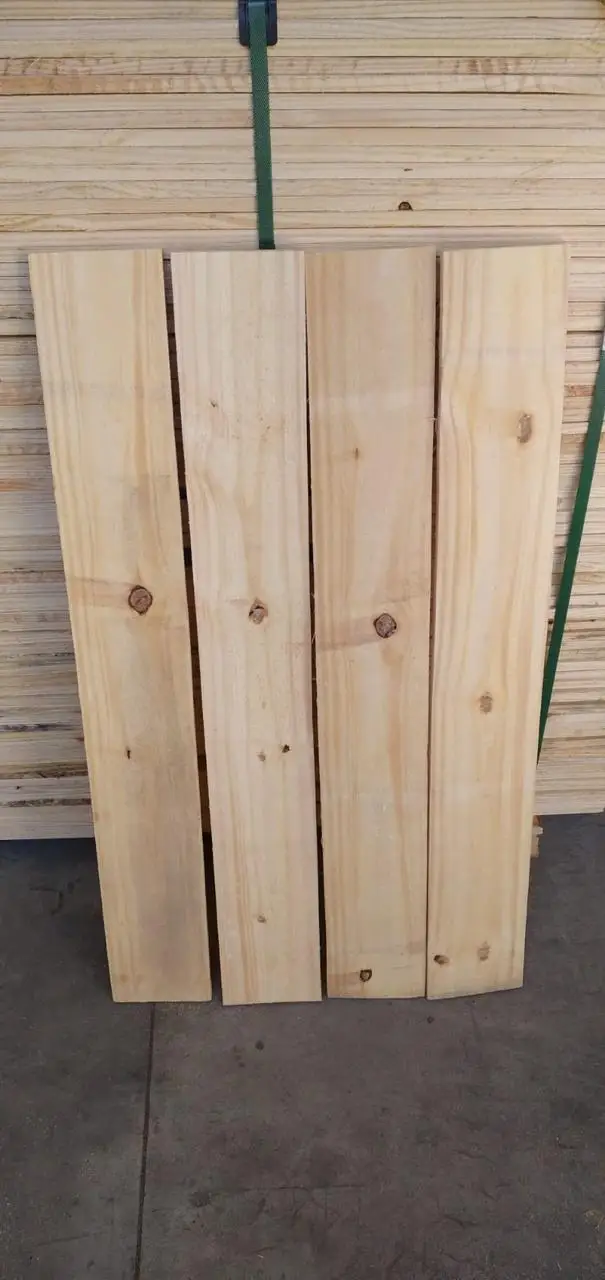
To specify pallet lumber in an order, write seven fields: species, treatment (KD-HT with a record), moisture range and the method used to measure it, dimensions with tolerance, grade with a limit for each defect, a bark rule and shipment evidence. Most disputes with a supplier start with a blank field, or with a bare letter (“grade A”) and no measuring method. What the purchase order says is what you can enforce.
Why pallet lumber specifications fail
Four failures show up every time a lot goes wrong:
- Wet wood. The order says “dry” and does not say how dry. Lumber above roughly 20% moisture, closed in a container, releases water that condenses and grows mould during the voyage. Nails loosen when a board dries after assembly. The difference between kiln drying and heat treatment is in pallet lumber: KD and HT.
- A tolerance that does not match the machine. The nominal size is right, but the board arrives 2 mm outside what the jig accepts. With no written tolerance, nobody is wrong.
- Wane and bark. Wane (the rounded edge of the log left on a corner of the piece) and bark get through because the order did not limit them. Bark also carries a rule: ISPM 15 requires debarked wood, with little tolerance for bark pieces.
- Mixed lots. Boards from different kiln charges, with different moisture, in the same package. The average looks fine and half the pieces are out.
What fields a pallet lumber purchase spec needs
Each field answers a question that, left open, becomes an argument at the dock.
| Field | What to write | Why it matters |
|---|---|---|
| Species | Pinus taeda and/or elliottii, or other | Density and resin change the pallet. See loblolly vs slash pine |
| Treatment | KD-HT, with temperature and time records for each load | Drying does not treat. ISPM 15 requires 56 °C at the core of the piece for 30 continuous minutes |
| Moisture | A range or ceiling in %, and the measuring method | “Dry” is not a number. The method decides who wins a dispute |
| Dimensions | Thickness, width and length in mm, each with under and over tolerance | Your machine or jig accepts only one window |
| Grade and defects | The grade plus a limit for each defect: knots, wane, blue stain, checks, insect holes | A grade letter means different things to different buyers |
| Bark | None, or a stated limit | Bark is a rejection reason under ISPM 15 |
| Shipment evidence | Photos of each layer, treatment record, certificate where relevant | It is what you hold if the lot arrives off-spec |
| Certification | FSC® 100% when the order is certified; origin dossier for EUDR | It exists only if the order asks for it. See FSC-certified lumber and EUDR |
How to write moisture: range, method and moment
Write three things together: the number, the method and the moment at which it applies.
The number. US Southern Pine grading rules (SPIB, 2021 edition) set KD and KD19 at 19% maximum and KD15 at 15% maximum, for pieces up to 2 inches thick. That ceiling applies at shipment and on delivery to the buyer, unless the load ships exposed to weather. For export pallets, 19% is the marking limit, not the target: wood exchanges water with the air until it reaches equilibrium (equilibrium moisture content, tabulated in the USDA Wood Handbook, FPL-GTR-282, 2021), and the drier it leaves the kiln, the more margin it has for the voyage. LG sawn pine leaves the kiln at 5% to 12%.
The method. State which method applies and which one governs in a dispute. ISO 4470 treats the electric meter as the screening method and oven drying as the only method applicable in a dispute. ASTM D4442 describes the oven: Method A is the higher-precision reference and Method B is the simpler one.
The moment. “At kiln exit” and “on arrival at destination” are different dates. Dry wood that sits in the rain goes wet again. Say where the number applies and where you measure.
How to write dimensions and tolerance
Thickness, width and length go into the specification as blanks the buyer fills in with the measurements of their own line: width ___ mm, thickness ___ mm, length ___ mm. LG cuts the lumber to the customer’s line measurements. What changes from one order to the next is the tolerance, and it follows three rules:
- One tolerance per dimension, for under and for over. A symmetric tolerance (“±1 mm”) hides the fact that, for your machine, one side usually hurts more than the other. Decide which.
- State the moisture content at which the size applies. Wood shrinks as it dries. The European standard EN 1313-1, for example, measures tolerance with the wood at 20% moisture (Swedish Wood, 2016).
- Use the real window of your line. Asking for tighter than your machine needs makes the lot more expensive; accepting wider than your jig allows stops production.
As a reference for what a published tolerance looks like: on grade A, LG works at −1/+2 mm on thickness, −1/+3 mm on width and −1/+3 mm on length. Your order defines which window your process accepts.
How to write grade and defects
The grade letter is not enough. “Grade A” and “grade B” mean different things to different buyers, and there is no official conversion between the Nordic, European and American systems. Write the grade and, next to it, the limit for each defect:
- knots: sound allowed? dead? what size?
- wane: up to what percentage of the length?
- blue stain and mould: accepted or not?
- bark, checks and cracks: accepted or not?
- insect holes: accepted or not?
LG grade A, for example, allows no blue stain, mould, bark, checks or cracks, or insect holes; it permits wane up to 10% of the length, sound knots and, occasionally, dead knots of 1 to 3 mm. The full table and the difference from grade B are in pine lumber grades explained. Heavy-load pallets, export pallets and one-way pallets call for different windows, so write the end use into the order.
What shipment evidence to ask for
Evidence exists for the day something arrives different from the order. Ask for it in writing:
- A record of the HT treatment for each load: core temperature and time. LG’s lumber is heat-treated in its own kiln. Whoever builds the pallet answers for the mark on the finished product. How to read the mark is in ISPM 15 stamp.
- Photos of each layer of the package at loading, so grade and bark can be checked before the load leaves.
- FSC certificate and origin dossier when the order is certified or has to meet the EUDR.
- Lot identification: which kiln charge, so a problem can be traced to its source.
How to check a lot on arrival
Checking is quick when the order already says what to measure. The routine:
- Define the lot. ISO 4470 deals with a homogeneous lot of one cross-section. Lots with different sections or kiln charges are checked separately.
- Draw pieces at random. ISO 4470 says to draw pieces from the lot at random (sampling per ISO 2859) and calculate the average. Do not pick the best-looking pieces or the top layer.
- Measure away from the ends. The ends dry faster than the middle and read low. Take more than one reading per piece.
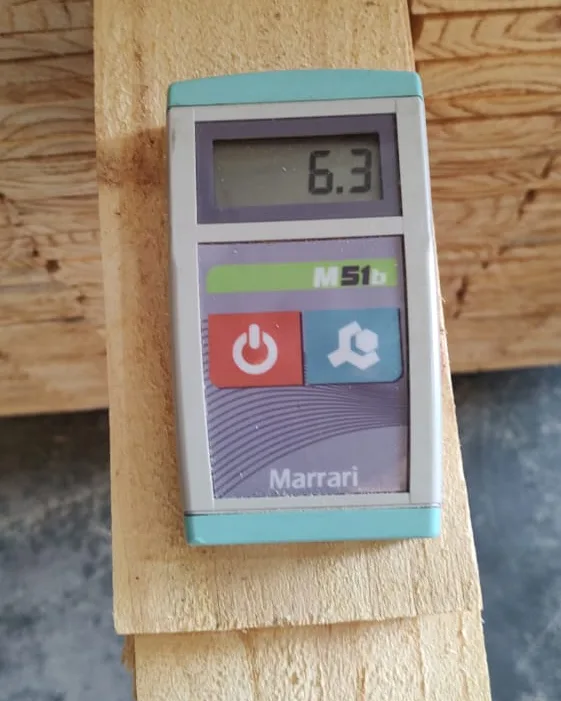
- Use the meter with correction. A pin meter needs correction for species and temperature; without it the reading is off. A capacitance (pinless) meter is sensitive to moisture near the surface. Both have limits: the FHWA guide, based on the Wood Handbook, gives the reliable range of commercial pin meters as 6% to 30%, and readings above 30% are qualitative only. A VTT study (Finland, 2000) found errors of about 1.5 to 2.5 moisture points in the laboratory and 2 to 5 points in industrial conditions, with readings drifting below 10%.
- For very dry wood, or any doubt, use the oven. Wood at 5% or 6% sits at the edge of a pin meter’s range. Cut a sample, weigh it, dry it in a laboratory oven until the weight stops falling and weigh it again (ASTM D4442).
- Check size and defects. Measure thickness, width and length with calipers or a tape on several pieces and compare with the written tolerance. Set aside pieces with defects above the limit and photograph them.
- Record before use. Photos, readings and lot number, on the day of arrival, before the wood enters the line.
A specification template to copy
Fill in the blanks. The blank fields are the measurements of your line; LG cuts to the agreed size.
| Field | Specification |
|---|---|
| Product | Sawn pine lumber for pallets |
| Species | Pinus taeda / Pinus elliottii |
| Treatment | KD-HT, with temperature and time record for each load |
| Moisture | ___ % to ___ %, measured by ___ (meter / oven); in a dispute the oven method applies (ASTM D4442) |
| Moment of measurement | at shipment and on arrival |
| Thickness | ___ mm, tolerance −___ / +___ mm |
| Width | ___ mm, tolerance −___ / +___ mm |
| Length | ___ mm, tolerance −___ / +___ mm |
| Grade | ___ |
| Knots | sound: ___; dead: ___ |
| Wane | up to ___ % of length |
| Blue stain, mould, checks, insect holes | ___ |
| Bark | ___ |
| Lot packaging | packages by layer, strapped, protected from rain |
| Shipment evidence | photos of each layer; HT record; lot identification |
| Certification | ___ (FSC® 100% / EUDR / none) |
| Volume | ___ m³ |
| Destination and incoterm | ___ |
Checklist before you send the order
- Species and treatment are written, with a record for each load.
- Moisture has a number, a method and a moment of measurement.
- Each dimension has an under and an over tolerance.
- The grade comes with a limit for each defect.
- Bark has a rule.
- Each lot is a single kiln charge and a single size.
- Shipment evidence is listed (photos by layer, treatment record).
- Certification and dossier are in the order, if needed.
- It is defined who measures on arrival and which method governs a dispute.
How LG Madeiras does it
LG cuts its sawn pine lumber to the customer’s line measurements. It leaves the kiln at 5% to 12% moisture, dried in LG’s own kilns since 2017 with the Marrari EcoPower MR500 system, which records every cycle, and heat-treated (HT) in the same kiln. The species are Pinus taeda and Pinus elliottii from planted forests, with FSC® 100% when the order is certified and a shipping report with photos of each layer.
Send the completed specification (dimensions, moisture, grade, certification and volume) and we reply with a proposal. For questions about export, see how we load and ship through the ports of Itajaí and Navegantes.
Sources: USDA Forest Products Laboratory, Wood Handbook — Wood as an Engineering Material (FPL-GTR-282, 2021); ASTM D4442, Standard Test Methods for Direct Moisture Content Measurement of Wood and Wood-Based Materials; ISO 4470, Sawn timber — Determination of the average moisture content of a lot (1981); FHWA, Moisture Content Measurement (timber bridge inspection guide, based on the Wood Handbook); SPIB (Southern Pine Inspection Bureau), grading rules, seasoning requirements; ISPM 15 (IPPC/FAO), revision adopted in 2018; EN 1313-1, as cited in Swedish Wood, Grading of sawn timber in Europe according to EN 1611-1 (2016); VTT, moisture meter study (2000); LG Madeiras export specification 2026. Information checked in November 2026.